Comparison of Ocular Biometric Parameters at High Altitude vs Low Altitude
Doi: 10.36351/pjo.v42i3.2218
DOI:
https://doi.org/10.36351/pjo.v42i3.2218Abstract
Purpose: To compare ocular biometric parameters inpatients of cataract at high and Low altitudes of Pakistan.
Study Design: Cross-sectional, comparative study.
Place and Duration of Study: KMDC, Karachi Metropolitan University from 1stSeptember to 31st December 2024.
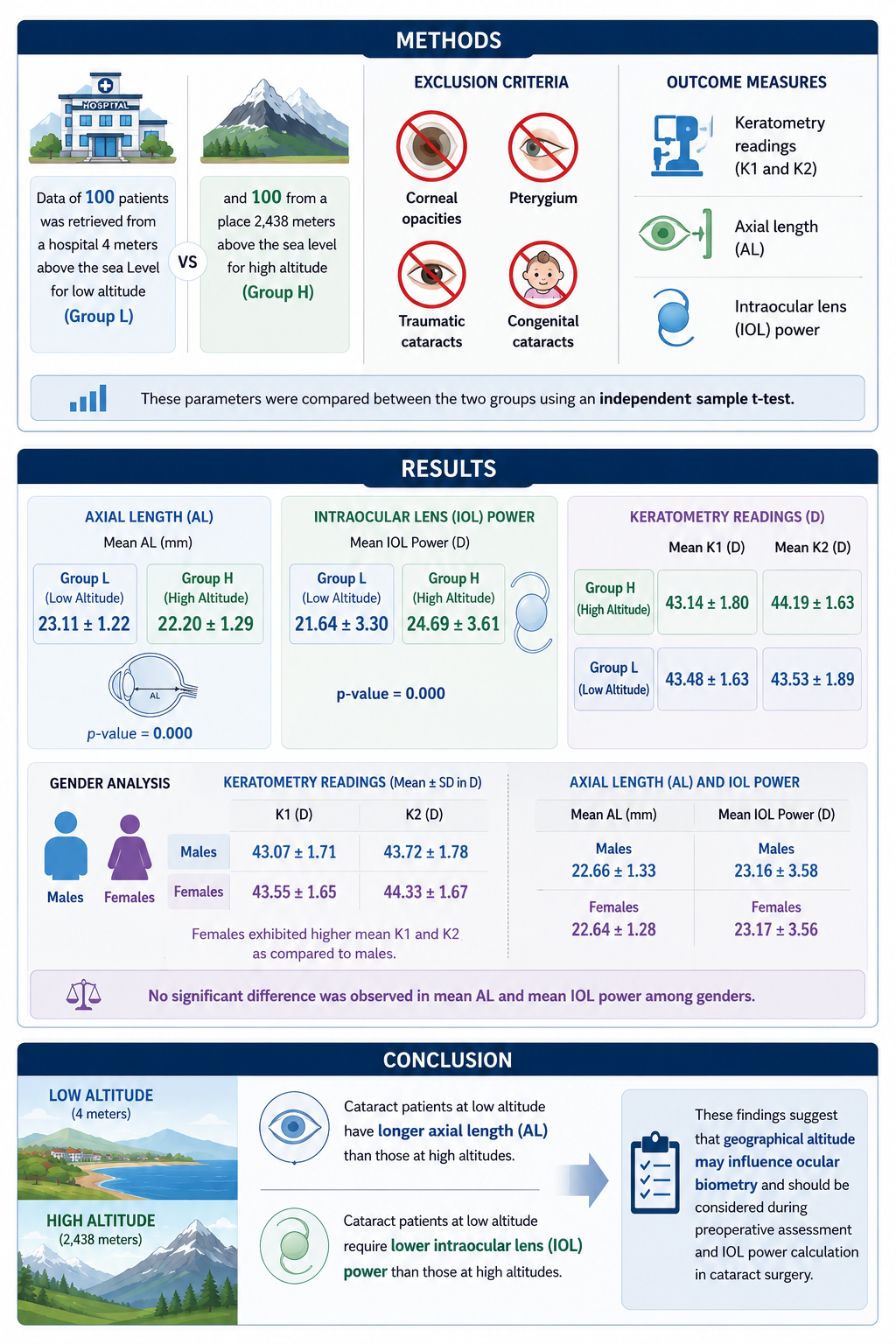
Methods: Data of 100 patients was retrieved from a hospital 4meters above the sea Level for low altitude (Group L) and 100 from a place 2,438 meters abovethesealevelforhighaltitude(GroupH).Patientswithcornealopacities,pterygium,traumatic,andcongenitalcataractswereexcluded.Keratometryreadings(K1andK2),axiallength(AL),andintraocularlens(IOL)powerwerecomparedbetweenthetwogroupsusinganindependentsample t-test.
Results: Group H had a shorter mean AL (22.2±1.29 SD mm) compared to Group L (23.11±1.22SDmm) with a
p-value=0.000. Group L required a lower mean IOL power (21.64±3.3D) than Group H (24.69±3.61D)witha
p-valueof0.000.The mean K1 and K2 for Group H were43.14±1.8D and44.19±1.63D,respectively,while for Group L, they were 43.48±1.63D and 43.53±1.89D.FemalesexhibitedhighermeanK1andK2ascomparedto males. No significant difference was observed in mean AL and mean IOL power among genders.
Conclusion: Cataract patients at low altitude have longer AL and lower IOL power than those at high altitudes. These findings suggest that geographical altitude may influence ocular biometry and should be considered during preoperative assessment and IOL power calculation in cataract surgery.
Downloads
Published
How to Cite
Issue
Section
License
Copyright (c) 2026 Erum Shahid, Muhammad Shahzaib, Uzma Fasih, Asad raza Jafri

This work is licensed under a Creative Commons Attribution-NonCommercial 4.0 International License.