Evaluating the Efficacy of Topical Insulin Compared with Preservative-Free Artificial Tears in Ocular Surface Restoration among Patients with Dry Eye Disease: A Randomized Controlled Trial
Doi: 10.36351/pjo.v42i4.2443
DOI:
https://doi.org/10.36351/pjo.v42i4.2443Abstract
Purpose: To evaluate the efficacy of topical insulin (1 U/mL) compared with preservative-free artificial tears in improving ocular surface parameters in patients with Dry Eye Disease (DED).
Study Design: Randomized Controlled Trial.
Place and Duration of Study: Department of Ophthalmology,Khyber Teaching Hospital, from Peshawar.
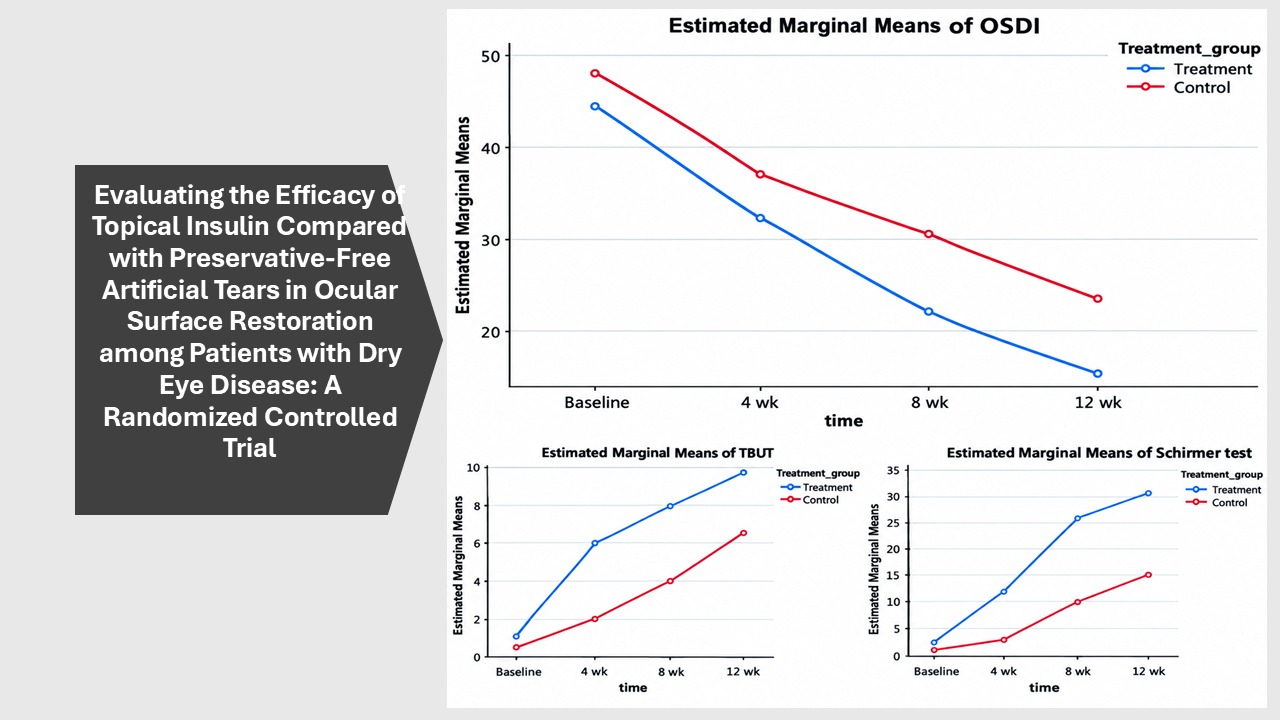
Methods: A total of 128 patients were enrolled in a prospective, randomized, participant-masked controlled trial. Patients meeting standardized DED criteria i.e Schirmer test <10 mm, tear break-up time (TBUT) <10 seconds, ocular surface disease index (OSDI >20) were randomized 1:1 to topical insulin group (IDG) or carboxymethylcellulose 0.5% artificial tears group (ATG), four times daily for 12 weeks. Primary outcome was the proportion achieving OSDI ≤20. Secondary outcomes were Schirmer test and TBUT. Repeated measures ANOVA and intention-to-treat analysis were performed.
Results: At 12 weeks, 89.06% of IDG patients achieved OSDI ≤20 versus 40.63% in the ATG (RR: 2.19, OR: 11.90). Schirmer test improvement was significantly greater in the IDG (4.75 ± 1.64 mm vs. 2.41 ± 1.24 mm), as was TBUT (4.34 ± 1.88 vs. 2.73 ± 2.28 seconds;). The insulin advantage was most pronounced in females, patients under 40, those with diabetes, and those with severe baseline OSDI >32. No major adverse effects were reported.
Conclusion: Topical insulin (1 U/mL) is significantly superior to artificial tears in improving tear production, tear film stability, and symptom burden in DED. These findings make it a cost-effective suitable option for DED in lower-middle income countries.
Downloads
Published
How to Cite
Issue
Section
License
Copyright (c) 2026 Shafiq Tanveer, Raseed ul Haq, Andaleeb Rabbi, Nazli Gul, Imran Ahmed

This work is licensed under a Creative Commons Attribution-NonCommercial 4.0 International License.