Effect of Different Soft Contact Lenses onTear Film Stability in Myopes
Doi: 10.36351/pjo.v42i2.2214
DOI:
https://doi.org/10.36351/pjo.v42i2.2214Abstract
Purpose: To assess the influence of soft contact lens wear on tear film stability in myopes.
Study Design: Quasi experimental study.
Place and Duration of Study: Social Security Hospital, Multan Road, Lahore, from February 2025 to May 2025.
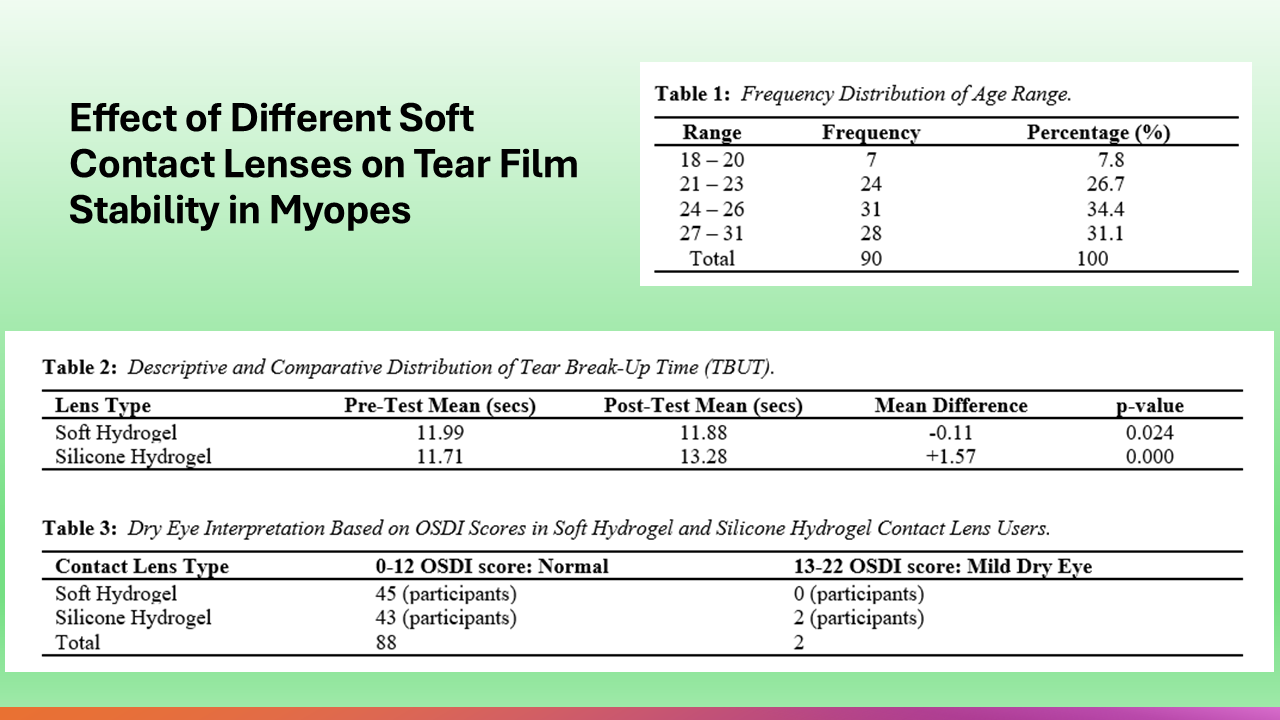
Methods: Myopic participants with no prior experience of wearing contact lenses were chosen and were divided into two equal groups based on the type of lens: soft hydrogel; and silicone hydrogel. Patients with dry eyes, refractive errors other than myopia, or using systemic medications were excluded from the study. Tear film stability was evaluated with Tear Break-Up Time (TBUT), conducted before and after one month of lens wear. Data analysis was performed using SPSS, Version 27. A p-value < 0.05 was considered statistically significant.
Results: The study enrolled 90 myopic patients. For TBUT, soft hydrogel lenses showed a minor but significant reduction from 11.99s to 11.88s (Mean difference = -0.11s, p < 0.050), while silicone hydrogel lenses exhibited a significant improvement from 11.71s to 13.28s (Mean difference = +1.57s, p < 0.001). Independent t-test revealed that silicone hydrogel lenses had significantly greater positive changes in TBUT compared to soft hydrogels, indicating improved tear film stability after one month of lens wear.
Conclusion: This study shows that wearing soft contact lenses impacts tear film stability in myopic patients, however a positive or negative response depends on type of lens material worn.
Downloads
Published
How to Cite
Issue
Section
License
Copyright (c) 2025 Sadia Saddiqi, Hadia Asif , Tayyeba Akram, Summan Razzaq, Bisma Arshad

This work is licensed under a Creative Commons Attribution-NonCommercial 4.0 International License.