Cosmetic Results of Tear Trough Incision in External Dacryocystorhinostomy
Doi: 10.36351/pjo.v42i2.2142
DOI:
https://doi.org/10.36351/pjo.v42i2.2142Abstract
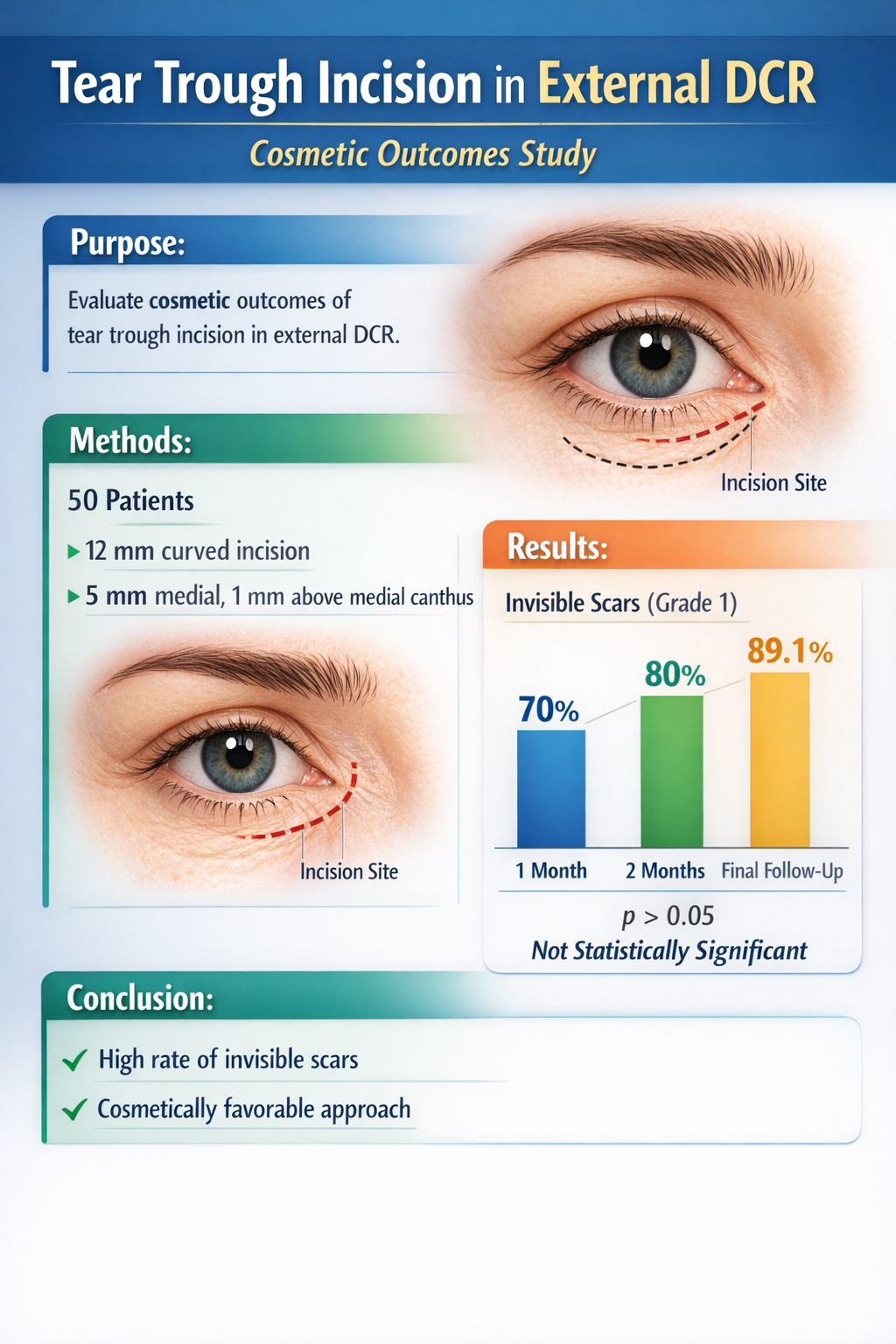
Purpose: To determine the cosmetic results of tear trough incision in patients undergoing external dacryocystorhinostomy for primary acquired nasolacrimal duct obstruction.
Study Design: Quasi experimental study.
Place and Duration of Study:Isra Postgraduate institute of Ophthalmology from May 2023 to November 2023.
Methods: This study included patients who underwent external dacryocystorhinostomy for primary acquired nasolacrimal duct obstruction (PANDO). The patientswere followed up for 4 months and scar scoring was done in the same room and light at100 cm from the patient. Grade 1 was labelled as invisible scar, Grade 2 when scar was minimally visible, Grade 3 when scar was moderately visible, and Grade 4 when scar was highly visible.
Results: A total of 50 surgeries were performed. An incision was given 5 mm medial and 1 mm above medical canthus and extended in the tear trough for 12 mm in a curved manner. Blunt dissection was conducted in horizontal plane to reach the periosteum; rest of the procedure was same as conventional DCR. Skin was closed in layers, orbicularis muscle with 6.0 vicryl suture and skin with 5.0 prolene suture. At first month follow up, ophthalmologist reported invisible scars (grade 1) in 35 out of 50 patients (70%),in the 2nd month follow up 40 out of 50 patients had invisible scar (80%). At final follow up invisible scars were observed in 89.1%(n=41) patients (p>0.05).
Conclusion: Tear trough incision produces good cosmetic results as the scar is hidden in tear trough area.
Downloads
Published
How to Cite
Issue
Section
License
Copyright (c) 2025 Wejai kumar Dembra, Muhammad Ashraf, Nazia Qidwai, Tauseef Mahmood, Anum Fatima

This work is licensed under a Creative Commons Attribution-NonCommercial 4.0 International License.